

As the industry looks toward 6G, future networks will need to do more than deliver higher speeds and lower latency. They will need to support highly distributed, AI-driven, multi-vendor environments spanning operators, cloud providers, edge infrastructure, devices, and industry partners.
That creates a critical challenge: how do we establish trust in networks that no single organization fully owns or controls?
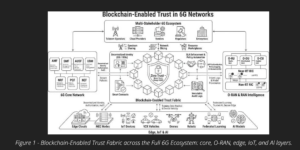
A new LF Decentralized Trust article, “Blockchain-Enabled Trust in 6G,” explores how blockchain and distributed ledger technologies can help provide a decentralized, cryptographic trust fabric for future networks.
Moving Beyond Centralized Trust
Today’s networks still rely heavily on centralized trust models. But 6G environments will span many more trust domains, including Open RAN deployments, federated AI systems, IoT and V2X ecosystems, and distributed edge clouds.
The article highlights permissioned distributed ledgers as one potential path forward. These systems restrict participation to known and authorized entities, making them better suited to telecom environments that require both decentralization and operational control.
Key 6G Use Cases
Blockchain-enabled trust could support several important 6G use cases, including:
- Identity and access: using decentralized identifiers and verifiable credentials for devices, network functions, applications, operators, and partners
- Open RAN security: supporting trusted infrastructure registries, xApp authentication, policy logging, and AI/ML model provenance
- Data sharing and auditability: anchoring metadata, access rights, timestamps, and hashes without storing raw data on-chain
- Federated learning and AI governance: helping verify model updates, trace contributions, and strengthen accountability across distributed AI systems
Why This Matters to the Open Networking Ecosystem
These challenges are closely tied to ongoing work in open networking, Open RAN, cloud-native automation, zero-touch operations, and AI-native network management.
As networks evolve toward 6G, trust will need to become a foundational design requirement, not an afterthought. Open source collaboration can help connect research, standards, and real-world deployments by enabling shared frameworks, reference implementations, and interoperable building blocks.
LF Decentralized Trust projects such as Hyperledger Fabric, Besu, Hiero, Hyperledger Cacti, and decentralized identity technologies offer important tools that can be explored alongside open networking platforms and telecom automation efforts.
Learn More
Trust will be one of the defining requirements of 6G. As future networks become more distributed, intelligent, and automated, the ability to verify identity, enforce policy, preserve auditability, and coordinate across organizational boundaries will be essential.
Read the full LF Decentralized Trust article, “Blockchain-Enabled Trust in 6G,” to learn more about the technical details, standards activity, and open source projects helping shape this future and how to get involved.
