

TL;DR
At Cloud Native Telco Day during KubeCon + CloudNativeCon Europe 2026, Yoshihiro Nakajima (NTT DOCOMO), Ranny Haiby (The Linux Foundation), Philippe Ensarguet (Orange), Hui Deng (Huawei), and Yanjun Chen (China Mobile) discussed how telecom operators are applying Agentic AI to network operations, orchestration, and service delivery. The panel focused on the gap between pilots and production, including observability, carrier-grade reliability, open source collaboration, and the need to choose the right AI approach for each networking problem.
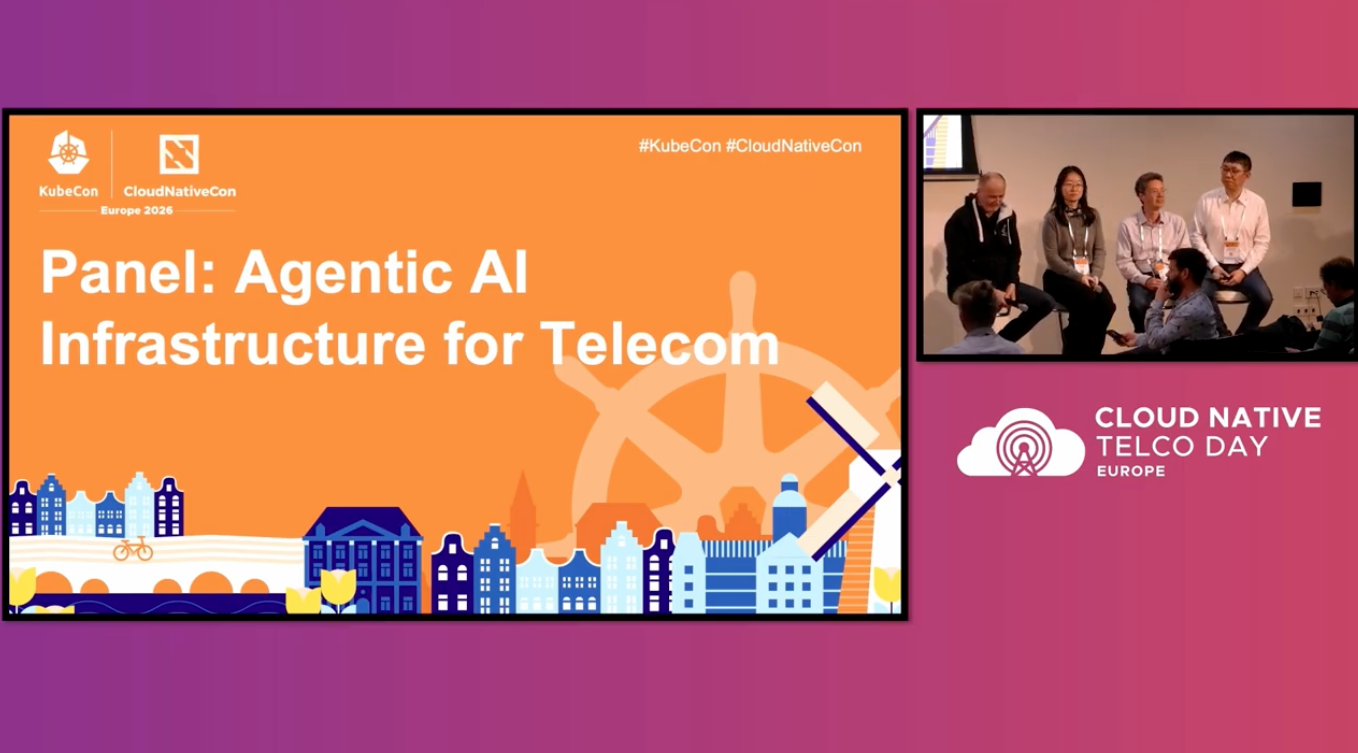
At Cloud Native Telco Day, during KubeCon + CloudNativeCon Europe 2026, Yoshihiro Nakajima (NTT DOCOMO), Ranny Haiby (The Linux Foundation), Philippe Ensarguet (Orange), Hui Deng (Huawei), and Yanjun Chen (China Mobile) explored how Agentic AI infrastructure is beginning to take shape for telecom networks.
Watch the full panel session here.
The panel opened with examples of how operators are already testing and beginning to deploy Agentic AI in telecom environments. Yoshihiro described agentic AI based lifecycle management for CNF deployment and operations, where prompts, language models, and orchestration tools can help automate complex operational workflows.
Philippe shared a security-focused use case from Orange involving cooperating agents for 5G core operations. The system brings together telemetry, security incident analysis, internal operational knowledge, and dynamically generated security rules to support network protection and service quality. He noted that the approach is currently deployed in two countries at Orange.
Yanjun described work at China Mobile to expose network capabilities through service-layer APIs and Agentic AI-powered workflows. In one pilot, users can express network quality requirements in natural language, and the system can analyze intent and adjust network behavior at runtime.
Ranny outlined how LF Networking projects are adapting to this shift. Some long-running networking and orchestration projects are adding Agentic AI layers, while newer projects are focused specifically on frameworks for AI networking applications and multi-agent orchestration. The broader goal, he said, is to provide reusable open source building blocks so organizations do not have to reinvent common components.
Much of the discussion focused on the challenge of moving from experimentation to production. Philippe summarized the issue directly: “Doing exploration and POC mode is super easy. Moving to production is like hell.” He emphasized that the hardest problems are not only technical. Production deployments require the right operational model, cross-functional teams, context engineering, shared memory, and observability across both infrastructure and AI layers.
Yanjun added that telecom environments have carrier-grade expectations that make deployment especially demanding. When Agentic AI is used to operate services or expose network capabilities to customers, operators need testing, benchmarks, specifications, and collaboration across vendors, operators, manufacturers, and application users.
Ranny also cautioned against treating LLMs and agents as the default answer to every networking problem. Some use cases may be better served by simpler and more predictable machine learning approaches. The important step is matching the problem to the right technology rather than rushing every use case toward autonomous agents.
The panel also touched on standards, runtime infrastructure, and hyperscaler platforms. Speakers discussed MCP, A2A, agent communication, lightweight runtimes, virtual machines, containers, latency requirements, sovereignty, resilience, and the role of open source in helping operators avoid lock-in while building carrier-grade systems.
Together, the discussion showed that telecom operators are moving quickly to explore Agentic AI, but production deployment depends on more than models and agents alone. The panel emphasized that carrier-grade Agentic AI infrastructure depends on observability, reliability, interoperability, operational discipline, and open source collaboration across the telecom ecosystem.
AI Disclosure
This post used artificial intelligence tools for research, structural assistance, or grammatical refinement. The final content was reviewed, edited, and validated by human contributors to LF Networking to ensure accuracy and alignment with our community standards. We are committed to transparency in the use of generative technologies within the open source networking ecosystem.

