

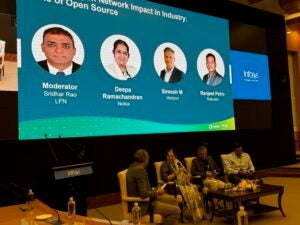
ONE Summit India brought together key visionaries, architects and developers across operators, vendors, integrators, academia, and open source communities for a packed day focused on where telecom is headed next: AI-native networking, cloud native infrastructure, and open collaboration as the operating model to get there. With representation from 35 organizations and a speaker lineup that included roughly 30% women, the event reflected both growing community scale and a broader set of voices shaping the future.
Across the program, three themes stood out.
1) Open source is shifting from consumption to contribution to adoption
A consistent message was that the industry has moved beyond using open source as a cost-saving tactic or innovation sandbox. Instead, it’s increasingly the foundation for production networks, especially as operators and vendors face pressure to automate faster, integrate across multi-vendor environments, and reduce the time and friction of interoperability testing.
Speakers reinforced that the real value of open source shows up in day-to-day outcomes: faster deployment cycles, more repeatable operations through automation, and a community-driven path to interoperability. OSPO strategies were also a recurring point of discussion, specifically how many organizations are evolving from consumption toward upstream contribution, which ultimately strengthens shared infrastructure and reduces duplicated work across the ecosystem.
2) AI For Networks and Networks for AI are here and “Agentic AI” is the next step but requires domain specific knowledge and alignment to data, protocols and existing stack.
AI was a major focus, but the conversation was refreshingly grounded. Participants were direct about why “generic GenAI” doesn’t map cleanly to telecom: data quality challenges, safety and accuracy requirements, complex legacy environments, multi-vendor stacks, real-time control loops, and uncertain ROI at scale.
The takeaway wasn’t that AI won’t work in telecom; it was that telecom needs telco-ready AI. The strongest forward-looking discussions centered on agentic AI: moving beyond copilots that assist humans, toward agents that can plan and execute operational decisions across domains like assurance, incident response, design, and change management. A critical requirement emerged: agents must integrate with the network layer through APIs, tools, and domain knowledge so they can act safely and effectively in deterministic, real-time control environments.
3) Open Source projects don’t operate in silos – support for LFN Super Blueprints, APIs, and projects across the entire stack need to work together into practical “how-to” building blocks
ONE Summit India highlighted the ecosystem’s continued shift from architecture debates to implementation pathways. Rather than treating projects as separate tracks, the event pointed toward a more integrated model where platforms and building blocks come together into deployable solutions, combining cloud-native infrastructure, automation frameworks, and network APIs.
That convergence showed up in discussions about blueprint-driven approaches, CAMARA-based capabilities, and cloud-native telco stacks, alongside project updates and demos that demonstrated how the community is turning shared components into repeatable deployment patterns.
The event highlighted the importance of End to End stack, including: Agentic AI, Governance and Standards, a look at India’s AI ecosystem, IOS-MCN — plus Linux Foundation and LFN project highlights fromm Essedum, ORAN- SC, SONiC, LFN Super Blueprints, Sylva, CAMARA, Nephio, and ONAP.
Looking ahead: capture, reuse, and scale what the community is building
Beyond the day’s sessions, ONE Summit India made one thing clear: there is a growing body of practical assets including presentations, demos, deployment lessons, and integration patterns that should be captured and reused. Several attendees noted the opportunity to build a more visible library of technical demos and “best of” content that can support everything from community onboarding to partner engagement and ecosystem storytelling.
Bottom line: ONE Summit India reflected an ecosystem that is increasingly execution-oriented. Open source is becoming the default path to automation and interoperability, AI discussions are maturing from hype to operational reality, and the community is aligning around shared building blocks (blueprints, APIs, and cloud-native stacks) that make AI-native networking achievable.
Join the Open Source community at Open Source Summit India (June 16-17 in Mumbai)
Open Source Summit India is where the open source community comes together to share what’s next, from the latest in cloud native, AI, security, and platform engineering to real-world stories from the teams building and operating at scale. Join maintainers, developers, architects, and business leaders for practical talks, hands-on learning, and the kind of hallway conversations that turn ideas into collaborations. Whether you’re modernizing infrastructure, shipping AI-enabled applications, or strengthening your open source strategy, this is the place to connect, learn, and help shape what’s coming next.

