

Author: Ciaran Johnston (Ericsson)
The Nephio developer community convened on September 26–27, 2025, at the Eurecom Campus SophiaTech in Biot, France—home of OpenAirInterface and a leading European engineering and research institution—for a two-day, hands-on workshop focused on evolving the Nephio codebase and documentation. The summit marked a major milestone on the path to the R6 release, bringing together core contributors to align on development priorities, refine tooling and release strategies, and strengthen documentation and collaboration practices.
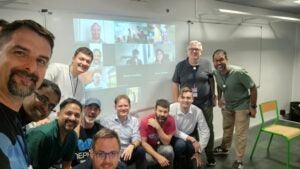
A Developer-Centric Agenda
The workshop agenda was tightly packed with technical sessions focussed on code quality improvements, integration with other ecosystems and improved technical and communications documentation. Some key highlights from the two days include:
-
Kpt Interworking:
A big focus was put on the usage of and interworking with kpt, the Kubernetes-native package management tool. The new maintainers of the kpt project overlap with the Nephio community and Nephio is heavily reliant on its capabilities. Discussions covered best practices for package composition, pipeline definitions, the KRM function catalog and the related SDKs. A clear goal was to ensure that kpt and porch are complementary functions and work seamlessly together. -
Documentation Improvements:
Recognizing the importance of clarity, usability and simplicity, the community dedicated time to discussing proposals to improve Nephio’s documentation. This included refining developer guides, clarifying API usage, and aligning on terminology. -
Release Strategy:
The current release process was reviewed, highlighing the challenges in getting a proper release, and a proposal to improve and streamline was discussed. The outcome of this needs to be reviewed with the TSC for the R7 release. -
Controller evolution:
The state of the Nephio controllers was presented, and proposals to simplify and deprecate aspects of these that are unused or unmaintained. This discussion maps into some of the rearchitecture work discussed. -
Kubenet integration:
Related to the Nephio controllers, the use of Kubenet and the possible improvements it brings once properly integrated were discussed. This is a challenging topic that will require effort but can bring significant gains. -
Scalability and characteristics:
Community members described challenges experienced in running Nephio in large-scale deployment scenarios, and discussed changes required including moving to a fully asynchronous operating model and improving the way the system interacts with git. -
Observability:
A key cornerstone of any automation system is the ability to observe the automation execution, so a discussion on how and why to introduce an observability framework into Nephio was welcomed by the community. -
Long-term architecture:
The community revisited the architectural principles underpinning Nephio, and considered synergies with standardization groups and other Linux Foundation projects such as Sylva. The impact of generative AI and the ability of Nephio to support simplified automation leveraging this paradigm-shifting technology was discussed. The need for a cohesive architecture with a well-defined core function and an independent set of use cases was presented as an enabler for these .
The workshop concluded with a shared vision, a prioritized list of action items, and strong momentum heading into the R6 release. The high level of engagement underscored the strength of the Nephio community and its commitment to advancing open, cloud-native network automation.
Catch up on the event:
Couldn’t attend in person? Check out the event photos and recordings (day 1, day 2)to relive the key moments and discussions from the R6 Developer Summit.
What’s Next
Stay tuned for an upcoming Nephio webinar, where we’ll focus on new onboardings, ecosystem synergies, and outreach efforts for evolving workgroups. More details will be shared soon!
Want to get involved?
Join the conversation on the Nephio Slack, contribute on GitHub, or visit the LFN Wiki for more information.
